Prestige Bias in Resume Screening
Hiring managers use diploma prestige as a shortcut instead of measuring actual ability.

Prestige bias in resume screening is the tendency to grade a candidate's ability by the name printed on their diploma or their last pay stub, rather than by what that candidate can actually do. It is a documented cognitive shortcut, not a conscious act of snobbery, and it appears twice on most resumes: once in the university line, once in the employer line. Both function the same way in a hiring manager's head. They stand in for competence without ever measuring it, and the research below traces how that substitution happens, who it rewards, and who pays for it.
How the brain shortcuts from where someone went to school to how good they are
Most bias research relies on what people say about their own decisions, which is a problem, because people are bad witnesses to their own shortcuts. A 2025 study in Behavioral Sciences by Ling and Wang sidestepped that by measuring brain activity directly, using event-related potentials (ERP) while subjects evaluated recruitment materials built around educational background. That method matters because it catches the bias forming below the level of self-report, before anyone has a chance to rationalize it.
The results confirmed what the "elite university effect" predicts: educational pedigree and Fortune 500 internship experience both moved evaluator ratings, and the two effects interacted in ways that went beyond simple addition. Candidates with an elite degree and a Fortune 500 internship scored higher than candidates with the same internship but a less prestigious degree. Prestige compounds rather than adding, the way interest compounds on a loan.
Academic pedigree seems to act as a first gate, a threshold an evaluator's brain uses to decide whether a candidate is even worth serious attention. Academic pedigree seems to act as a first gate, a threshold an evaluator's brain uses to decide whether a candidate is even worth serious attention. Once a candidate clears that gate, the brain doesn't reset. It keeps filtering every later piece of information through the schema the pedigree line already built. A so-so internship read as unremarkable coming from a state-school grad reads as promising coming from someone with an elite-university line at the top of the page. Same words on the page, different meaning assigned to them.
How elite firms institutionalized prestige bias as hiring policy
Lauren Rivera's 2015 book Pedigree: How Elite Students Get Elite Jobs (Princeton University Press) is the field's foundational account of what this looks like once it's baked into an actual hiring process. Rivera conducted 120 in-depth interviews with hiring decision-makers and observed hiring at a top firm firsthand, and what she found is that "merit," as elite employers define it, is not a neutral standard. It's a checklist that happens to match the resume of someone who grew up with money.
Her interviewees weighted a specific, narrow bundle of signals: a degree from a prestigious school, especially an Ivy, participation in high-status leisure activities like squash or lacrosse, and prior work experience at a peer firm. None of those three signals measures whether someone can do the job well. All three measure whether someone has already spent years around institutions that produce those signals, a proxy for family income and social access long before it's a proxy for skill.
Rivera's sample concentrated in investment banking, management consulting, and corporate law, the sectors where this kind of filtering runs deepest and the stakes, in terms of pay and career trajectory, are highest. "The right stuff," in her account, requires economic, social, and cultural resources most candidates never had a chance to acquire on their own merit.
What the callback numbers reveal about who prestige helps and who it leaves behind
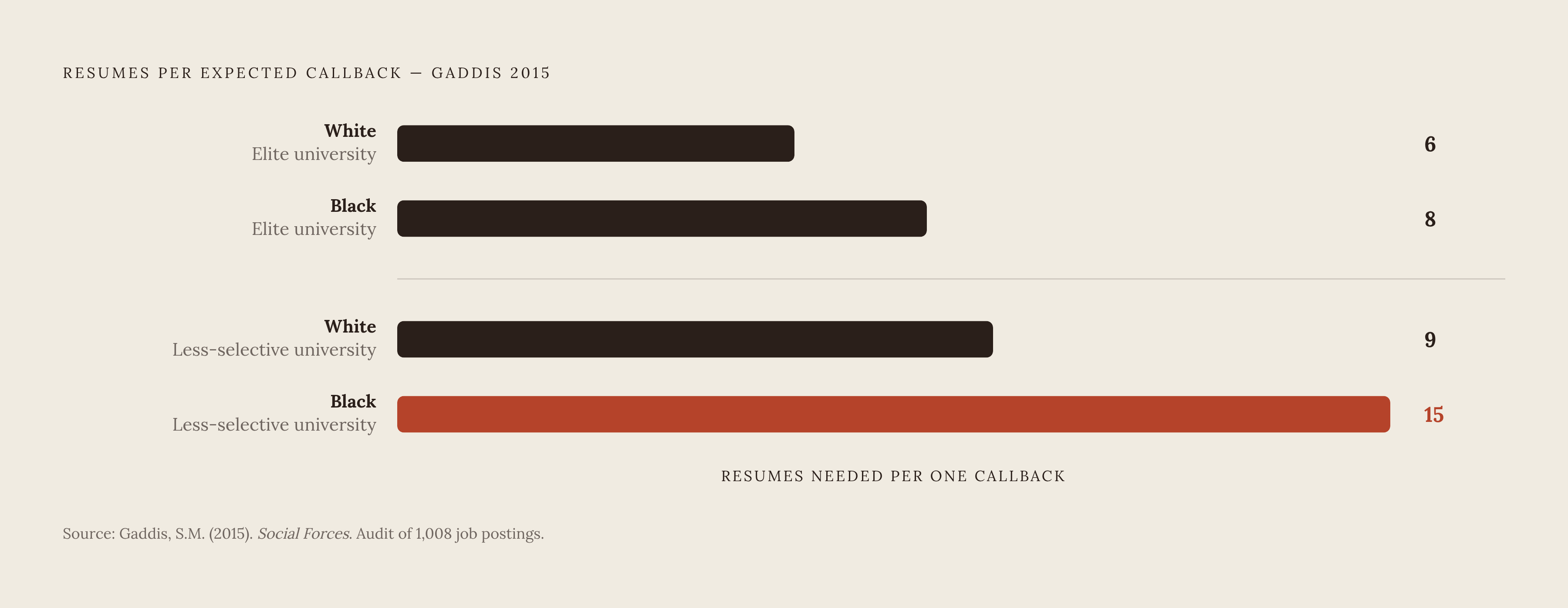
S. Michael Gaddis ran the experiment that puts hard numbers on Rivera's argument. In "Discrimination in the Credential Society" (Social Forces, 2015), Gaddis submitted matched resumes to 1,008 job postings on a national job-search site, varying only the university's prestige level and a signal of the candidate's race.
The headline finding is that elite degrees don't help everyone the same amount. It's that they don't help everyone the same amount. According to the University of Michigan's reporting on the study, a white candidate from an elite university needed to submit around six resumes to expect one employer response. A Black candidate with the identical elite degree needed to send out around eight resumes to expect one response, nearly the same disadvantage as a white candidate from a far less selective school, who needed nine. A Black candidate from a less-selective university fared worst of all, needing roughly fifteen applications to expect a single response. The elite credential, in other words, bought the Black candidate nothing that a white candidate from a mediocre school didn't already have for free.
And the penalty doesn't stop at the callback. When employers did respond to Black candidates, Gaddis found those responses skewed toward jobs with lower starting salaries and lower status than the jobs offered to equally credentialed white candidates. Getting through the door isn't the same as getting through it into the same room.
Current employer practice that keeps prestige filtering alive and growing
Employers haven't quietly retired this behavior, they've formalized more of it. A Veris Insights survey of over 150 companies found that 26% now recruit from a fixed, short list of schools, up from 17% in 2022. That's a meaningful jump in a short window, and it runs against the direction most public diversity commitments claim to be heading.
The formal list isn't even the full picture. Companies without an official shortlist still describe concentrating recruiting effort on "target schools," while technically leaving the application open to everyone else. The practical effect is close to identical: candidates from off-list schools get to apply, they just don't get looked at with the same seriousness.
A Spark Admissions survey of 84 C-suite executives found that 51% call university prestige an "important" or "critical" factor in their hiring decisions. Separately, 42% of companies say they maintain a preferred university list, and 38% say they recruit primarily from prestigious universities. Only around a third of companies describe their hiring as focused on qualifications regardless of where a candidate went to school. On these numbers, qualification-first hiring is the minority practice, not the norm.
The effects of prestige bias moving into automated screening at scale
None of this bias needed artificial intelligence to exist. What AI does is take a bias that used to run through one recruiter's judgment at a time and apply it uniformly, instantly, across every resume the system touches.
Pin's audit of more than 33,000 job postings and over 37,000 recruiter sourcing searches shows exactly where the bias gets baked in, and it's earlier than most people assume. The bias gets baked in at the search filters recruiters set before any ranking happens. It's the search filters recruiters set before any ranking happens. Employer-prestige filters showed up in 70.7% of sourcing searches, the single most common filter in the entire dataset. Minimum years-of-experience filters came in second, at 45.7%. And of every minimum-tenure filter recruiters set, 96% landed on exactly twelve months, a default setting doing the filtering rather than human judgment. That's a default setting doing the filtering, not human judgment.
Name-based bias then stacks on top of whatever prestige filtering already happened. Wilson and Caliskan's research on large language model resume rankers found a preference for white-associated names in 85.1% of comparisons, and in over three million paired, head-to-head comparisons, Black male names won zero. A 2025 follow-up replicating the work at the same three-million-plus comparison scale gave the pattern a name, the "Illusion of Neutrality" effect: keyword-matching systems look neutral on their face, but they reproduce the same bias underneath, with no visible trace of it in the output, because the matching criteria themselves encode it.
A divergent finding on AI and prestige markers
Not every study lines up behind that story: a team at the Gies College of Business built an LLM-based resume-matching tool in partnership with an HR consulting firm and tested it against four resume variables. A team at the Gies College of Business built an LLM-based resume-matching tool in partnership with an HR consulting firm and tested it against four resume variables: language style, prestige markers (more or less prestigious schools and companies), career gaps of one or two unexplained years, and keyword stuffing. They ran five resume variants against twenty job descriptions spanning five job categories, from business and managerial roles to data and machine-learning positions.
Career gaps got penalized clearly. Keyword stuffing hurt scores significantly. But prestige markers, the variable most of the rest of this research says should matter most, showed no statistically significant effect on the model's scoring, and neither did language style.
That doesn't cancel out Wilson and Caliskan's findings, and it doesn't overturn Rivera's or Gaddis's. It means the effect of prestige signals inside automated tools may depend heavily on how a specific tool is built and trained, and the Gies team's own small sample size limits how far the finding can travel. A larger dataset, examining more granular gap lengths and a wider set of variables, would be needed before anyone treats this as evidence that automated tools solved the problem prestige bias created.
Why organizations acknowledge the problem but don't fix it
This is hard to explain away as ignorance. By the end of 2025, 83% of companies planned to use AI to screen resumes, and 67% of those same companies openly say their own AI tools could introduce bias. That's a company adopting a tool while stating, on the record, that the tool might discriminate. That's a company adopting a tool while stating, on the record, that the tool might discriminate.
Asked what kind of bias they worry about, companies most commonly pointed to age and socioeconomic background, followed by gender and race. These organizations know about and document the risk. It's named, it's ranked, and it's adopted anyway.
AI screening is reported to cut time-to-hire roughly in half and trim recruitment costs by something in the range of 20 to 30%, which explains the practice. AI screening is reported to cut time-to-hire roughly in half and trim recruitment costs by something in the range of 20 to 30%. Those numbers move budgets and they move quarterly headcount targets, and a bias risk that's diffuse and hard to attribute to a single bad hire loses that argument almost every time. Layer institutional inertia on top: target-school lists, preferred-employer filters, and applicant-tracking-system defaults mostly get inherited from whatever the last recruiting cycle set up. Nobody sits down and chooses the 12-month tenure filter fresh each year. It's just already there, already running, already excluding people before anyone on this cycle's hiring team even logs in.
The legal and regulatory pressure now building around biased screening
The law is starting to catch up to what the audits already show, unevenly and jurisdiction by jurisdiction. New York City's Local Law 144 now requires bias audits for automated employment decision tools used on candidates in the city. Illinois's HB3773 and Texas's TRAIGA add state-level AI governance, though both currently carry limited provisions specific to hiring. In the EU, the AI Act's Annex III classifies hiring systems as high-risk, with fines running up to a substantial sum or 3% of a company's global annual turnover for violations at that tier (a considerably steeper penalty, running to a much larger sum or 7%, applies to prohibited AI practices outright, a separate and more severe category).
Enforcement is starting to move too, not just rulemaking. The EEOC's settlement with iTutorGroup established that a company can face federal enforcement over discriminatory screening even when software, not a human, made the discriminatory call.
The case to watch is Mobley v. Workday. Derek Mobley, who is African American, over 40, and disabled, applied to more than 100 positions at companies he believed were using Workday's screening tool, and was rejected every time. In July 2024, Judge Rita Lin of the US District Court for the Northern District of California let the case proceed, ruling on a novel theory that Workday itself could potentially be held liable as an agent of the employers using its software. That opens vendors, not just the companies that hire through them, to discrimination liability for the first time under that theory. The EEOC has made clear that employers remain responsible under existing anti-discrimination law regardless of whether a human or an automated tool makes the screening call. The software doesn't inherit a lighter standard just because a person didn't personally make the call.
Sources
- MSBA research examines bias in AI résumé screening
- AI Resume Screening Bias in 2026: A 33,000-Job Audit - Pin
- How Educational Background Influences Recruitment Evaluation: Evidence from Event-Related Potentials
- 83% of Companies Will Use AI Resume Screening by 2025 (Despite 67% Acknowledging Bias Concerns) - The Interview Guys
- researchgate.net
- brookings.edu